-
January 18, 2026
- Share:
-

-

-

-


In recent software development trends, the traditional Waterfall approach has become obsolete. With the advancements in the IT world, the software delivery life cycle needs a more integrated approach. This is where Agile testing comes into the picture. In Agile testing teams, the QA team works closely in collaboration with software developers to validate functionality and integrate the system at every stage of the sprint. To ensure that the life cycle and the code move together throughout development, teams rely on Agile Testing Quadrants. Agile Testing Quadrants helps teams to organize testing activities and ensures quality is built into the product.
In this blog, let’s explore the four Agile testing quadrants in detail and understand how different types of test cases fit into each quadrant.
What are Agile Testing Quadrants?
Brian Marick introduced The Agile Testing Quadrants, aiming at providing a framework to organize testing activities throughout the Agile Development Lifecycle. This is done by classifying the tests across two dimensions. One is the intended audience, which includes the technical developers or business stakeholders, the other, actual purpose of the test which is to support the development team.
With the help of these quadrants, the teams can focus on automating the tests that are repetitive or technical and save time for manual testing on areas that need human judgment. Agile testing quadrants, thus provide teams with a definite roadmap to make testing effective and ensure smooth functioning of the software, meet business goals, and minimize bugs in production environment.
Why use Testing Quadrants in Agile Testing?
The below pointers helps us understand how Agile Testing Quadrants plays an important role in Agile testing.
- Ensures complete test coverage
The quadrants make sure that all important testing areas, like functional, non-functional, technical, and business-facing, are covered. This lowers the risks of gaps in the test strategy. - Aligns testing with Agile principles
By promoting continuous testing and early feedback, the quadrants align closely with Agile principles such as collaboration, adaptability, and incremental delivery. - Guides automation and manual testing decisions
Teams can easily identify which tests should be automated for efficiency and which require manual execution. - Supports early risk identification
Testing starts early and runs throughout development, so teams can find bugs and performance problems before they go into production.
The Structural Foundation of the Quadrants
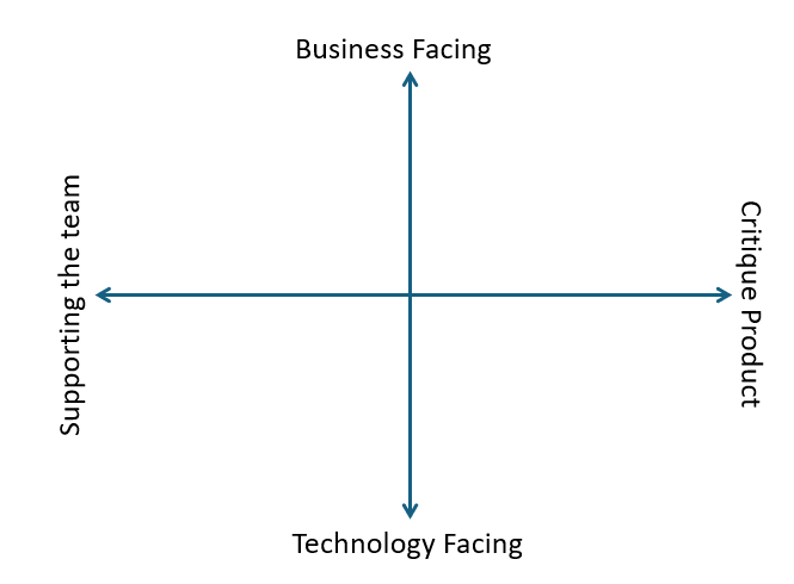
In order to implement this framework effectively, it is essential to understand the two primary axes that define it. These dimensions help the testing teams to classify their efforts based on the intended audience and the ultimate objective of the test case.
The Horizontal Axis: The Audience
- Technology-Facing: These tests are curated specifically for the technical team. They check the internal logic, code structure, and system architecture. The objective is to guarantee that the software engine works as required.
- Business-Facing: These tests are curated for stakeholders and users. They ensure that the software works in a way that offers value to the business and meets the end-user expectations.
The Vertical Axis: The Purpose
- Support the Team: These activities are proactive. They help the team build the software correctly by providing immediate feedback during the development phase. They define the path the code should follow.
- Critique the Product: These activities are reactive and investigative. They look at the finished increment to find weaknesses, edge cases, or areas where the user experience might fail.
The Four Agile Testing Quadrants Explained
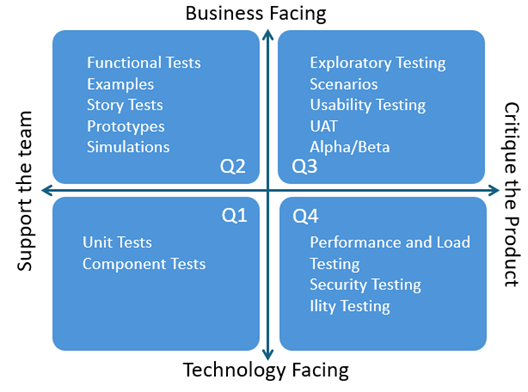
The following section explains the different types of test cases that fit into each quadrant. Let’s now deep dive and understand the four Agile testing quadrants in detail.
Quadrant 1: Code Correctness (The Foundational Layer)
Quadrant 1 (Q1) forms the base of the quality pyramid. The tests falling under this quadrant are technology-facing and primarily focused on internal health of the application.
Core Objective: Functionality test to ensure error free functioning of individual units of the code.
Primary Test Types:
Unit tests – They check small functions.
Component tests – They check how the small functions work together.
The Role of Automation: These tests need to be automated and integrated into the CI pipeline so that they run every time a developer commits any code.
Benefit: By detecting the bugs at this stage, the cost of fixing them is very low.
Quadrant 2: Functional Alignment (The User’s Requirements)
Quadrant 2 (Q2) focuses on the business perspective while still offering support the development team. This helps define what the team is actually supposed to build.
Core Objective: To ensure the business requirements are met by the features being developed.
Primary Test Types: Functional tests, story-based tests, creation of prototypes or wireframes.
The Role of Automation: These tests can be automated using tools like Selenium. To ensure visual elements align with the design, some manual checking can also be taken up.
Benefit: Ensures the features meet the customer requirements.
Quadrant 3: User Experience (The Human Perspective)
Quadrant 3 (Q3) looks at critiquing the product from a user stand-point. This business facing domain is most effective with a professional tester’s intuition.
- Core Objective: Test the product against human perspective. Answer questions like “Is this easy to use?”, “How does the system handle unexpected behaviour?”
- Primary Test Types:
- Exploratory Testing – Testers explore the application to find logic gaps. User Acceptance Testing (UAT) and Usability Testing are some other types of tests in this quadrant.
- The Role of Manual Testing: Since this domain is about human perspectives, it is almost entirely manual. Only some repetitive tests can be automated.Benefit: This ensures user acceptance of the software, making it usable.
Quadrant 4: Technical Security and Stability (The Stress Test)
Quadrant 4 (Q4) returns to a technology focus but critiques the product’s performance and safety.
- Core Objective: To ensure the system is robust enough to survive in a production environment.
- Primary Test Types: Performance Testing (how fast is it?), Load Testing (can it handle 10,000 users?), and Security/Penetration Testing (is the data safe from hackers?).
- The Role of Automation: Q4 requires specialized automated tools (like JMeter or Burp Suite) because a human cannot manually simulate thousands of simultaneous users or complex cyber-attacks.
- Benefit: This protects the company from crashes and data breaches, which are often more expensive than functional bugs.
Best Practices for Implementation
Understanding the quadrants alone is not sufficient; a team must very well understand how to apply the knowledge within a fast-moving sprint.
1. Avoid Linear Thinking
One of the most common misinterpretation is that teams must complete the first quadrant Q1 before proceeding to the 2nd quadrant Q2. In reality, these activities overlap. While a developer writes a unit test (Q1), a tester might be performing exploratory testing (Q3) on a feature finished the day before, while a DevOps engineer runs a load test (Q4) on the staging environment.
2. Foster Collective Responsibility
In a mature Agile team, quality is not the only responsibility of a QA Department.
- Developers owns the quality of Q1.
- Product Owners are focus in the success of Q2.
- Testers act as consultants and experts in Q3.
- Specialized Engineers support technical complexities of Q4.
3. Strategic Automation
To maintain speed, teams must automate repetitive work as possible. A thumb rule is to automate the verification (Q1, Q2, and Q4) so that users have the time and energy for exploration which is the third quadrant(Q3).
Overcoming Challenges Across the Agile Testing Quadrants
Even with a clear vision, teams often encounter. Recognizing these at early stages can save a project from failure.
- The “Ice Cream Cone” Anti-Pattern: This Anti-Pattern occurs when a team ignores Quadrants Q1 and Q2 automation and carries out all their testing manually in the third quadrant Q3. This approach results to a slow and expensive process where bugs are detected too late in the testing phases.
- Ignoring Non-Functional Risks: Skipping Q4 test cases carries significant risks. However, a feature that works perfectly in 2nd quadrant Q2 but fails under load in Quadrant Q4 is a failure for end user.
- Siloed Communication: If their is no coordination between the developers Q1 and testers Q3, there are significant risk factors of missing out on the bugs that could have been detected earlier.
The Agile testing quadrant represent a holistic approach to software health. By maintaining a balance between technology-facing tests with business-facing tests and balancing the support of the team with the critique of the product, you ensure a well-rounded strategy. This framework allows teams to move fast without breaking things, delivering software that is stable, secure, and highly valuable to the end-user.