-
September 28, 2026
- Share:
-

-

-

-


On August 1, 2012, Knight Capital deployed new trading software. Within minutes, an old piece of code that was supposed to have been retired began generating unintended trades. In just 45 minutes, the company lost approximately $440 million before the system was shut down.
The incident showed that having testers, engineers, and individual test cases isn’t enough. Software can still fail when changes interact with legacy code, integrations, deployment environments, and conditions that weren’t adequately considered before release.
That’s where a software testing strategy comes in. Instead of treating testing as a final checklist, a testing strategy helps teams decide what needs to be tested, which risks deserve the most attention, what should be automated, and where manual or exploratory testing is still necessary.
In this guide, we’ll explore the different software testing strategies, how to choose the right approach, how to build a testing strategy, and how automation, risk-based testing, and shift-left practices fit into the process.
What Are Software Testing Strategies?
A software testing strategy is a plan that lays out what your team will test, how you’ll test it, and in what order.
At a technical level, a software testing strategy defines the scope of testing, the types of testing you’ll run (functional, performance, security, and so on), the tools and environments you’ll use, and how you’ll measure whether testing worked.
It lays out the long-term approach to guide every release, sprint, or project a team works on. Deciding how much manual work gets replaced by scripts and AI-driven tools is an important part of the strategy.
Why Every QA Team Needs a Testing Strategy
Without a clear testing strategy, QA can become reactive. Testers decide what to test based on intuition, developers may skip unit tests when deadlines are tight, and regression suites grow until they become slow and difficult to maintain.
The result is costly: bugs escape into production, releases are delayed, and teams spend more time fixing issues that could have been caught earlier.
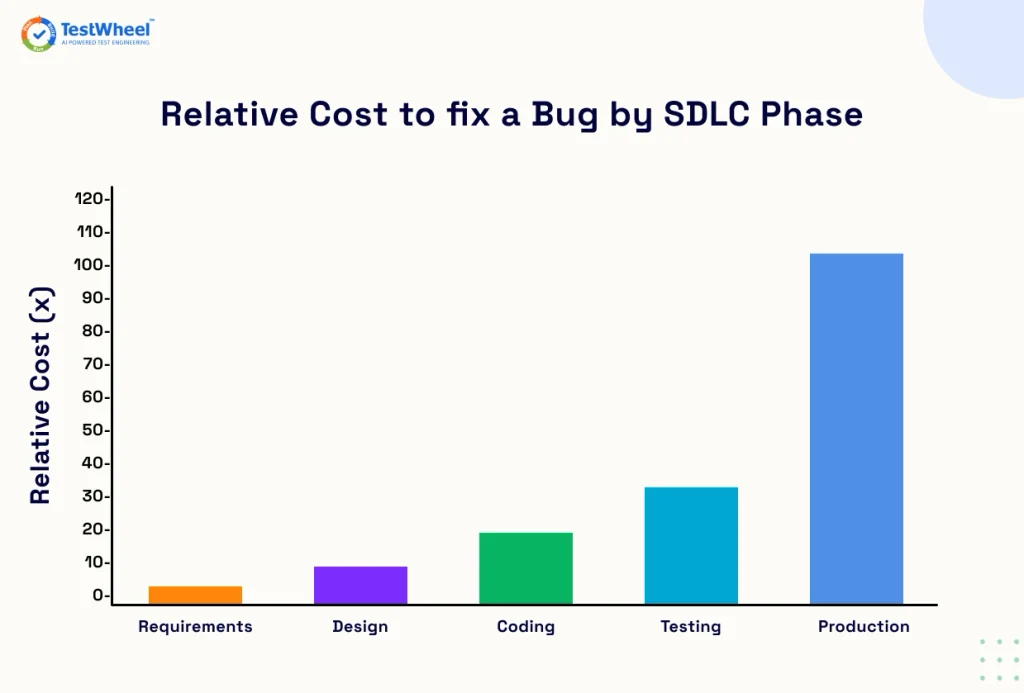
A testing strategy provides a structured approach to what to test, when to test, and how to test. It helps teams prioritize high-risk areas and catch defects early, when they are generally faster and less expensive to fix.
This is where a well-planned strategy can directly reduce software testing and maintenance costs. Early testing, targeted automation, and risk-based coverage help prevent teams from spending valuable time on unnecessary or repetitive testing while reducing expensive production fixes.
Automation can further reduce costs by handling repetitive regression, API, and functional checks. Meanwhile, testers can focus their expertise on exploratory testing, usability, and complex scenarios that require human judgment.
Ultimately, a testing strategy is not just about finding more bugs. It is about finding the right bugs earlier, using resources efficiently, reducing rework, and improving confidence in every release.
Test Plan vs Test Strategy in Software Testing
| Test Strategy | Test Plan | |
|---|---|---|
| Scope | Applies across every project and release | Written for one specific project or release |
| Lifespan | Set once, revisited only when the approach itself changes | Rewritten every release cycle |
| Owner | QA leadership or a testing center of excellence | The project’s test lead or QA engineer |
| Contains | Testing types, tools, environments, automation vs. manual split | Exact test cases, schedules, browsers/devices, who is running what |
| Changes when | The org shifts its approach to quality, like adopting shift left | Scope, timeline, or resources for that release change |
A test strategy is your restaurant’s overall approach to cooking, and a test plan is the exact recipe you follow for tonight’s special.
A test strategy is broad. It applies across projects and doesn’t change from release to release.
A test plan is narrow. It’s written for one specific project or one specific release. It includes details like the exact test cases, who’s running them, what hardware or browsers are involved, and the deadline for finishing.
A mid-size company might have a testing strategy around “prioritize automation for regression testing and manual testing for new features.” Every project team then writes their own test plan that follows said rule, but fills in the specifics for their particular app.
Principles of Software Testing Strategy
These ground rules come from decades of teams making mistakes and learning things the hard way.
- Testing can prove bugs exist, not that they don’t. No amount of testing can guarantee an app is 100% bug-free. But it can reduce risk to a level your business can manage.
- You can’t test everything. A shopping app might have thousands of combinations of items, discounts, and payment methods. Testing every combination is not possible. A good strategy picks the ones that matter most for business value.
- Start early. A typo in a requirements document is easy to fix. The same mistake, caught after the app has shipped to ten thousand users, becomes expensive.
- Context dictates the strategy. A hospital records system, where a mistake affects patient safety, needs a different software testing strategy, as opposed to a casual mobile game. Risk tolerance is key to the plan.
- Defects cluster. A small number of modules usually cause most bugs. These are often the modules that were rushed or coded by many developers over time. Put more effort into those trouble spots.
Types of Software Testing Strategy
Teams usually pick a mix of these types based on their product, timeline, and risk tolerance. QAs might run static reviews during planning, risk-based dynamic tests before release, and exploratory tests as a final sanity check.
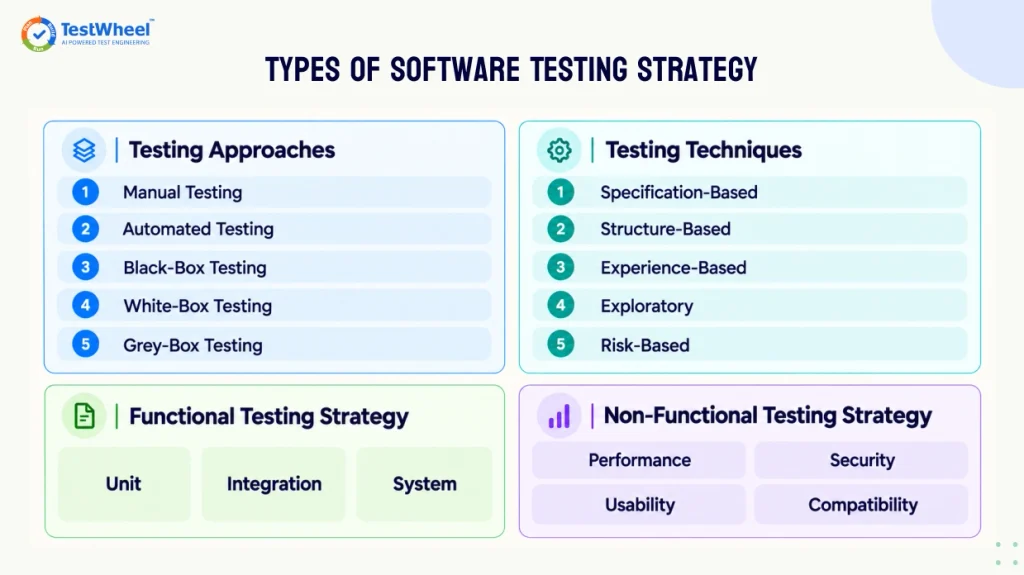
Testing Approaches
- Manual Testing: Humans run test cases step by step without using tools.
- Automated Testing: Software tools and scripts run repetitive tests quickly, with minimal human error.
- Black-Box Testing: Testing the software’s functions without looking at the internal code.
- White-Box Testing: Testing the internal logic, structure, and code lines.
- Grey-Box Testing: A combination of both, using partial knowledge of the internal code.
Testing Techniques
- Specification-Based: Creating tests directly from requirements and user stories without seeing code.
- Structure-Based: Writing tests based on code logic and coverage goals, like statement or branch coverage.
- Experience-Based: Using a tester’s intuition, domain knowledge, and past error patterns to find bugs.
- Exploratory: Unscripted testing and learning done at the same time to uncover hidden issues.
- Risk-Based: Effort concentrated on the parts of the app most likely to fail or most costly if they do. A banking app, for example, would put more testing hours into the money transfer feature than into the “About Us” page. The key is test case prioritization.
Functional Testing Strategy
Functional testing asks if the feature does what it’s supposed to do. For example, if a user taps “Add to Cart,” does the item actually show up in the cart?
A functional testing strategy usually breaks this down by testing level.
- Unit tests check one small piece of code in isolation, like a function that calculates a discount.
- Integration tests check whether different pieces work together, like whether the discount calculation syncs correctly with the payment system.
- System tests check the whole app end to end.
For a deeper look at how this plays out on real websites and web apps, this guide to web application testing types and strategy might help.
Non-Functional Testing Strategy
Non-functional testing asks if the app works well. For example, does the checkout button still work when ten thousand people are shopping during a Black Friday sale?
This bucket includes:
- Performance testing (speed and stability under load).
- Security testing (can someone steal data or break in?).
- Usability testing (is it easy to use?).
- Compatibility testing (does it work the same on an old Android phone as it does on a new iPhone?).
Non-functional testing isn’t optional. A shopping app that lets you add items to a cart perfectly, but takes twelve seconds to load a product page, will still lose customers.
Components of Software Testing Strategy
These are the practical building blocks that go into a strategy document:
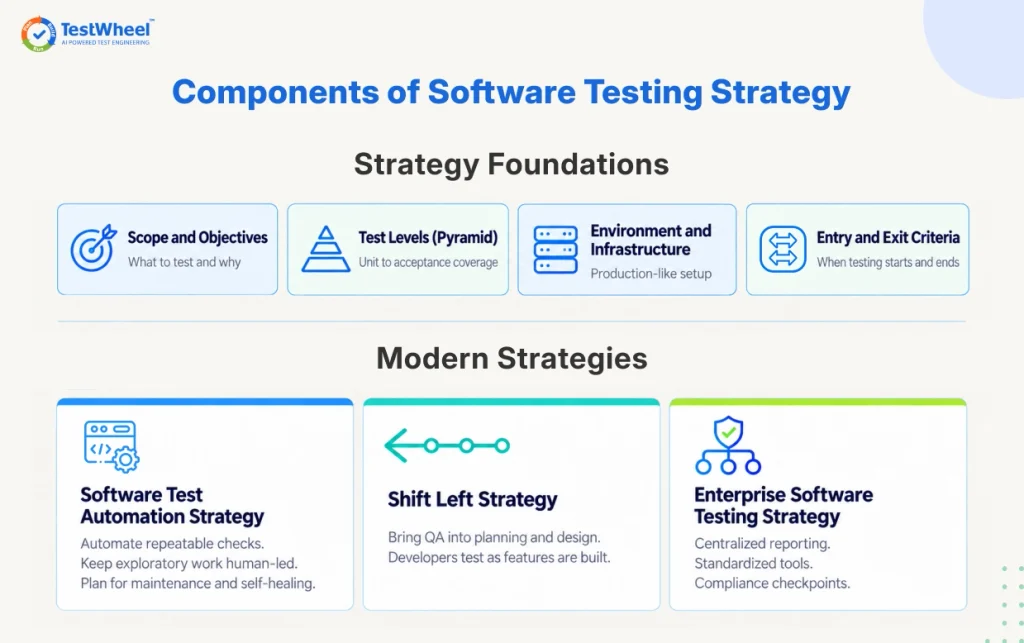
- Scope and Objectives: Defines which parts of the software will be tested and what goals the testing aims to achieve.
- Test Levels (Pyramid): Distributes QA effort and resources across unit, integration, system, and acceptance tests, so testing doesn’t lean too heavily on one level.
- Environment and Infrastructure: Sets up test servers and data to resemble the real production environment. This helps deliver accurate test results.
- Entry and Exit Criteria: Sets the rules for when testing can start and when it’s officially finished.
Modern Testing Strategies
The testing world has changed. Apps ship faster, teams are smaller, and AI has entered the picture. Here are three modern approaches that are appropriate in this context:
Software Test Automation Strategy
A software test automation strategy decides which tests get automated, which stay manual, and how automation fits into your release pipeline.
Repetitive checks, like confirming a login page works after every code change, are perfect for automation because they run the same way every time. One-off exploratory testing or usability checks are better left to a real person.
A well-built automation strategy also plans for maintenance. Automated tests break when the app’s interface changes, and teams have to account for the time this takes to fix.
This is also one of the biggest advantages offered by AI-driven self-healing, which can automatically adjust a test when a button moves or a label changes. It cuts down on the constant fixes that automated suites demand.
Shift Left Strategy in Software Testing
The phrase “shift left” refers to moving testing earlier in the timeline, closer to when the code is first written.
Developers write and run tests while they’re still writing the feature, instead of throwing it to a separate QA team weeks later. It also means testers get involved from the planning and design phase.
If you want a step-by-step breakdown of how to implement this, have a look at this practical guide to shift left testing.
Enterprise Software Testing Strategy
An enterprise software testing strategy has to deal with a scale problem.
It uses dozens of apps, built by different teams, in different programming languages, integrating with each other through APIs. All of them need to meet the same compliance and security standards. A single missed test in one system can cause a ripple effect across five others.
At this scale, strategy has to include:
- Centralized test reporting so leadership can see quality across the whole portfolio.
- Standardized tools so every team isn’t reinventing its own testing setup.
- Clear compliance checkpoints.
This becomes especially important in regulated industries. Government and defense software, for instance, needs to meet specific security certifications before it can be deployed. This is why some testing platforms build in support for strict government compliance requirements from the start.
Advantages of Software Testing Strategy
A solid software testing strategy typically leads to the following:
- Fewer surprises at release time: Planned testing catches problems while there’s still time to fix them without high costs.
- Better use of limited time: A strategy tells you where to spend more testing hours instead of spreading effort evenly across low-risk and high-risk areas.
- Consistency across projects: New team members can read the strategy document and quickly understand how testing works in this ecosystem. Saves onboarding and training time.
- Stronger business alignment: Testing connects to what the business gets value from, like software uptime during a big sale.
- Easier audits: Regulated industries need proof that thorough testing has occurred and covered the right areas. A documented strategy provides the proof of this.
Limitations of Software Testing Strategy
Before shaping your first testing strategy, or refining your existing ones, be aware of what it cannot do, and where it might need extra effort:
- It takes time to build: A solid strategy for a large system can take more than a few days. Teams that skip it because they feel rushed will lose more time later when they have to fix more bugs because of missed tests.
- It can go stale: A strategy written for a monolithic app might not fit a system that has since moved to microservices. It needs regular review and updating based on how the software and its market have changed.
- Over-engineering is a risk: A three-person startup doesn’t need the same strategy as a bank with 400 engineers. A strategy too heavy for your team’s size creates busywork.
- It can’t predict everything: No strategy anticipates every edge case. Strategies reduce risk; they don’t eliminate it.
- Tooling and skill gaps: If a strategy assumes the team can build automated API tests, it won’t work because nobody has that skill yet. It has to match the actual capabilities of each team.
Software Testing Strategies in the SDLC
In a well-run development lifecycle, tests run at every stage.
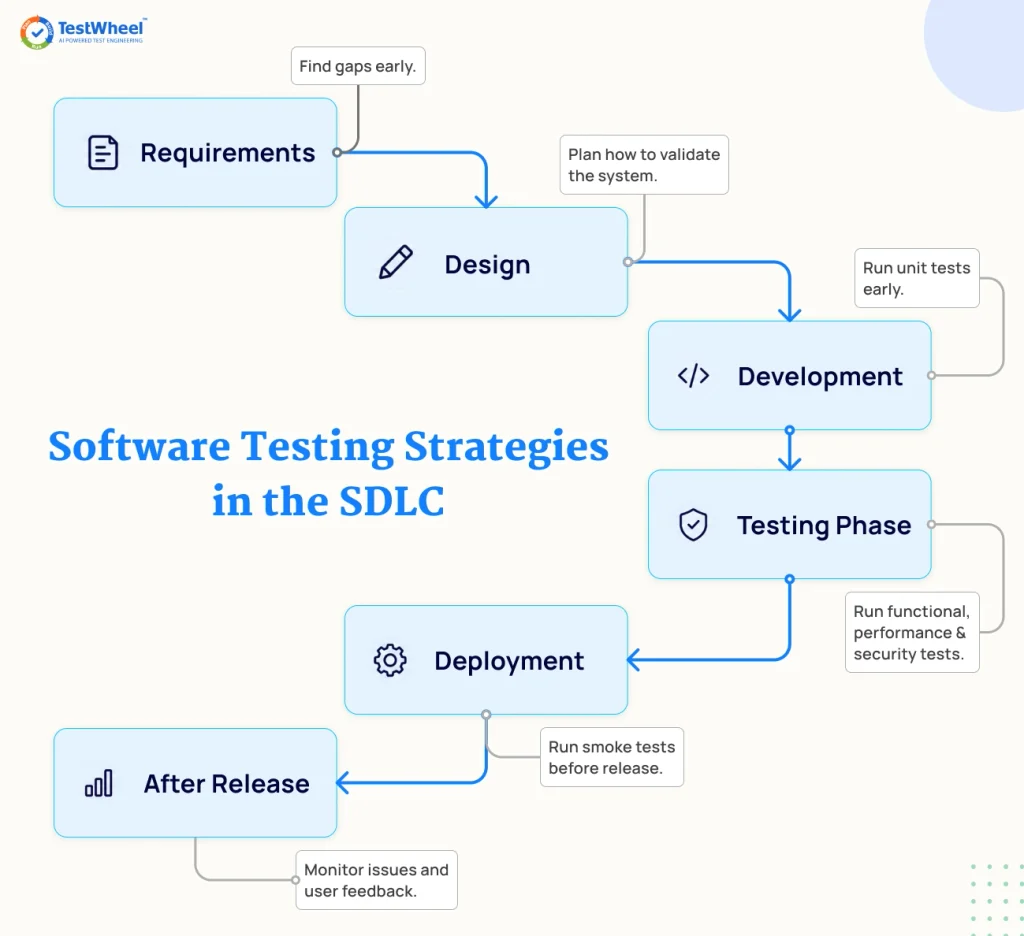
- During requirements gathering, testers review documents for gaps or contradictions before code gets written.
- During design, they plan how the system will be validated while the architecture is still flexible.
- During development, developers run unit tests as they write code, which is where shift left shows the most impact.
- During the testing phase, QA runs functional, performance, and security checks against a more complete build.
- During deployment, smoke tests confirm the release didn’t break anything critical.
- After release, monitoring and user feedback keep scanning for issues that pre-release testing could not predict.
These stages are connected, not separate. A bug found during requirements review should change how the design gets tested, and a bug found in production should inform decisions on what gets tested next time.
Final Takeaway
A software testing strategy helps a team catch problems before they reach users. Whether you’re a three-person startup team or a company running testing across dozens of applications, your strategy will decide success or failure.
Decide what matters most, test that first, and revisit the plan as your product and team change.
Want to learn more about strategies explore over 14 Api Testing Strategies Next.
FAQs
A software testing strategy is a high-level plan that defines what gets tested, how it gets tested, and in what order, across an entire project or organization.
A test strategy is a broad, long-term approach that applies across projects. A test plan is a detailed document written for one specific project or release. It outlines the exact test cases, schedule, and responsibilities.
Common types of software testing strategies are static testing, dynamic testing, black box testing, white box testing, gray box testing, risk-based testing, and exploratory testing. Most teams combine several of these types.
Shift left testing means moving testing earlier in the development process, so developers and testers catch bugs while code is being written instead of finding them after the application goes live.
Larger organizations run many interconnected applications that are often built by different teams. A formal strategy keeps testing consistent, makes compliance easier to prove, and prevents a bug in one system from breaking another.
Risk-based testing focuses the most testing effort on the parts of an application most likely to fail or those that will cause the most damage if they fail.
A test automation strategy specifically decides which tests should be automated versus run manually. It also lays out plans for ongoing maintenance as the application changes, rather than automating everything by default.
AI can convert plain-English descriptions into automated test scripts, suggest test cases based on an app’s structure, and self-heal automated tests when small UI changes would otherwise break them. An AI-driven platform like TestWheel does all the above.
A small team doesn’t need a heavy, formal document. But it’s recommended to create at least a short, written plan covering what to test first and how much to automate. This saves a fair amount of time compared to testing without any agreed approach.
A strategy should be reviewed whenever the application architecture changes significantly, such as moving to microservices. Otherwise, it should be reviewed at least once a year, since tools, team size, and risk areas shift over time.