-
June 19, 2026
- Share:
-

-

-

-

Shift left testing is one of the highest-impact changes a software team can make to reduce defects, cut incident response time, and ship with more confidence. Here is what it actually takes to implement it.
10 years of QA management, and here’s something I’ve seen in every team I’ve worked with.
QA gets handed a build two days before a release deadline. Bugs pop up everywhere. Developers are context-switching back to code they haven’t touched in three weeks.
Everyone’s pulling late nights. And at the end of it all, bugs still slip into production.
Shift-left testing exists specifically to stop this from happening. Yet, it’s still one of the most misunderstood and unevenly implemented practices in software quality verification.
This article breaks down how shift-left software testing works in practice and how to implement it without disrupting every team’s workflow.
What Is Shift-Left Testing?
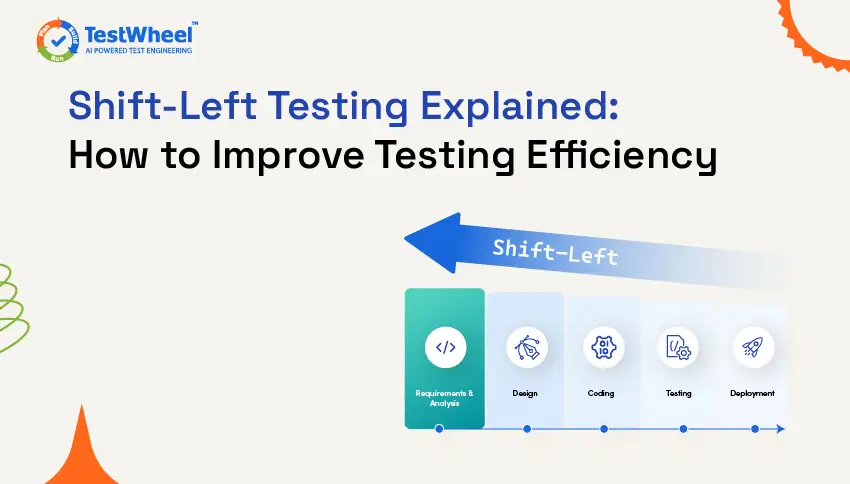
Shift-left testing is an approach that shifts quality assurance activities earlier in the software development lifecycle (SDLC). It requires testing to begin during the requirements and design phase rather than after development is complete.
Picture the SDLC as a horizontal timeline: requirements and design sit on the left, coding in the middle, testing and deployment on the right. In traditional waterfall development, QA was firmly on the right. Shift-left testing moves it towards the left.
What “Earlier” Means in Practice
In a team actually practicing shift-left software testing:
- QA engineers attend sprint planning and requirement reviews.
- Developers write unit tests while they are building feature code. They can also create tests before development using test-driven development (TDD).
- Automated tests run in the CI/CD pipeline on every commit, before code is reviewed or merged
- API contracts are validated early in development, before any UI is built
- Static code analysis flags vulnerabilities at the point of writing.
What Shift-Left Testing Is Not
A few persistent misconceptions worth clearing up:
- It does not mean only early-stage testing. Shift-left doesn’t eliminate the need for thorough testing before release. Teams that only focus on early testing skip integration and end-to-end testing. Bad idea.
- You cannot shift left once and be done. The shift-left approach is a continuous testing practice embedded in how a team works.
- It is not the same as writing more tests. Shift-left is about when and where testing happens, not just test volume.
Why the Traditional Testing Approach Breaks Down
According to a NIST economic impact study, software defects cost the US economy $59.5 billion annually, and earlier detection substantially reduces remediation costs. Every team that has managed a production incident knows the real cost isn’t the code fix. The incident response, customer impact, rollback, post-mortem, and the sprint that got derailed are the real consequences of late testing.
A developer who wrote a function three sprints ago no longer holds it in working memory. The requirements that drove their decision may have been revised. The product manager who wrote the original spec may be on a different team now. What should be a 30-minute fix becomes a two-day dig through commit history and Confluence pages that nobody has updated in a while.
Late-stage testing with the traditional approach brings about a series of expensive, disruptive, context-destroying fire drills that never seem to stop.
The Shift-Left Approach: What It Looks Like on a Real Team
The shift-left approach is a set of habits across every stage of development, each designed to reduce the distance between when a bug appears and when it gets caught.
- Requirements and design: Most defect reports trace back to an ambiguous requirement, instead of a coding error. When a QA engineer asks, “What happens if the user submits this form with an empty phone field?”, they just closed a defect before the SDLC even started. No bug ticket or sprint disruption. The cheapest fix in software.
- Development phase: TDD and BDD embed testing into writing code. The developer writes the test first, it fails, then they write the code to make it pass. It forces teams to set down a definition of what “done” means before anyone builds anything.
- CI/CD pipeline: Every push triggers the suite of unit tests, API tests, and static analysis. Nothing merges without passing through a quality gate. The feedback loop shrinks to minutes, and developers find bugs while context is still fresh.
- Code review: QA in a code review is asking whether the code can actually be tested. Issues like tight coupling and hidden dependencies are maintenance problems as well as signals to indicate bad design. Catching that before the merge costs far less than discovering it three months later.
The Real Challenges of Shift-Left Testing
Shift-left testing is more than a cultural pivot plus a few new tools. Here is what teams actually run into when trying to implement the change:
Cultural resistance
Developers push back because testing has never been their job. QA engineers worry their role is being taken by devs. Managers hesitate because there is a short-term productivity dip while the team rebuilds its protocols. More often than not, organizational friction rather than tooling gaps will be the primary barrier to adoption.
The skill gap
A senior manual tester with years of exploratory testing experience does not automatically know how to write unit tests or assess a user story for edge cases. That gap only closes with deliberate training over time.
Test maintenance overhead
Here’s a real example from a Series B startup in March 2024:
According to a QA industry analysis, test maintenance consumes up to 50% of QA team time on projects with large end-to-end suites.
400 automated end-to-end tests. At one Series B startup in March 2024, two senior QA engineers were spending 60% of their week fixing tests broken by a frontend component library update.
180 tests failed, not because features broke, but because CSS selectors changed.
The team had celebrated hitting 400 tests six months earlier.
The fix comes from more discipline around the test pyramid. A heavy base of fast, stable unit tests. Fewer integration tests. A selective layer of end-to-end tests covering only critical paths.
Resistance from legacy environments
Older monolithic codebases are hard to test. They are also designed in ways that make testing literally impossible without refactoring it, and you can’t safely refactor it without tests.
That is the catch-22 at the center of every legacy shift-left flow. (Sources: Parasoft / Bitfield Consulting / ImpactQA)
Shift-Left vs Shift-Right Testing: Why You Need Both
Shift-left and shift-right testing are not competing strategies. You do not have to choose between them
What Each One Does
Shift-left catches defects before they reach users. Shift-right tells you what happens after bugs reach users.
Shift-right testing covers everything that becomes visible under real user conditions: A/B tests, canary deployments, feature flags, production monitoring, chaos engineering. These are not fallback options for teams that failed to shift left. They are a fundamentally different category of testing.
| Shift-Left Testing | Shift-Right Testing | |
|---|---|---|
| When | Before and during development | After deployment, in production |
| Goal | Prevent defects from reaching users | Validate real-world behavior |
| Methods | TDD, BDD, CI/CD gates, static analysis | A/B testing, canary deploys, chaos engineering, monitoring |
| Blind Spot | Cannot simulate real production load | Uses real users as the detection system |
| Best for | Catching logic errors, integration failures | Catching performance degradation, UX issues at scale |
What You Miss Without Shift-Right Testing
Unit tests passing means the logic is correct in isolation. It does not mean that your service is healthy.
A microservice can pass every test in your suite and still silently degrade under production traffic loads that your staging environment could not simulate. Memory leaks, connection pool exhaustion, and third-party API timeouts under real concurrency often do not show up in a green CI pipeline. Shift-right tests catches them.
What You Miss Without Shift-Left
A pure shift-right approach means your production environment and real users are your primary bug detection system. Every defect that reaches production carries a cost: customer trust, incident response time, engineering hours redirected from the next feature.
How High-Performing Teams Use Both
DORA research shows that elite engineering teams deploy more frequently and recover from failures faster than low performers. It comes from using shift-left to prevent defects from reaching production, and shift-right to learn from production behavior and feed those signals back into development.
Shift-left without shift-right gives you confidence in your tests but not in your system. Shift-right without shift-left means you are always reacting to bugs but never preventing them.
Shift-Left Automation: The Technical Foundation
Shift-left software testing involves the embedding of automated tests directly into the development pipeline so that quality checks happen continuously without human intervention. Here’s how to set up the hierarchy of this layered structure.
- Static analysis on commit. Tools like SonarQube analyze code as it’s pushed, flagging security vulnerabilities, code smells, and potential bugs before any test runs.
- Unit tests on build. Developers run their full unit test suite locally before pushing code. The CI engine re-runs them on every commit. Any build that fails unit tests does not advance.
- API tests on merge. Before any pull request is merged, automated API tests validate that the service contracts are solid. APIs are the ideal first target for shift-left automation because they’re stable and testable much earlier than the UI.
- End-to-end tests on deployment to staging. Selective automated end-to-end tests cover the critical user paths, with emphasis on “selective”. Teams cannot run every possible end-to-end test on every deployment because those pipelines will take hours and eventually get turned off.
- Quality gates that block progression. This is a critical piece of shift-left automation. If test failures can be overridden or ignored, the feedback loop breaks. No tests, no merge. Failed quality gate, no deploy. Keep this non-negotiable.
According to DORA’s 2024 State of DevOps Report (based on 39,000+ respondents), elite engineering teams deploy 182 times more frequently than low performers and have an 8 times lower change failure rate. The common denominator is automated quality gates at every pipeline stage. (dora.dev)
Four Types of Shift-Left Testing
| Type | When Testing Happens | Best For |
|---|---|---|
| Traditional | After each module, before integration | Teams transitioning from waterfall |
| Incremental | Within each sprint | Agile teams building test-as-you-go habits |
| Model-based | Before any code is written | Complex systems, fintech, healthcare |
| DevOps/Continuous | On every commit via CI/CD | Mature teams with automated pipelines |
Shift-left is not a single gear you shift into. It exists in stages. Here is what each stage will likely play out for real QA teams.
- Traditional shift-left moves testing earlier within a waterfall project, so QA begins after each module is complete rather than after the entire build is finished.
This is a modest start. But for a team that previously discovered critical defects two weeks before a hard release deadline, even this version will free up meaningful time. Limited ceiling, but it’s a real improvement.
- Incremental shift-left embeds testing inside each sprint, so every user story has defined acceptance criteria before development starts. Tests are written as part of the exercise that defines what counts as “done”.
A developer no longer closes a ticket and throws it to QA. The ticket is not done until the test passes. No more “it worked on my machine” conversations, because the passing criteria were agreed on before anyone wrote any code.
- Model-based shift-left testing validates system design and architecture before any code is written. Testers and developers work together to examine state machines, data flows, and system behavior under edge conditions at the design stage. They catch errors in decisions that will be expensive to undo. For example, a fintech team building a payment reconciliation system would use model-based testing to validate transaction state transitions before any processing logic is coded in.
- DevOps/continuous shift-left automates testing across every stage of the CI/CD pipeline, with quality gates that block bad code from advancing without human intervention.
Every commit triggers the suite. A bug introduced at 2pm gets surfaced by 2:07pm, while the developer still has the context to fix it. Defects don’t travel too far before they get flagged.
Most teams do not jump straight to continuous shift-left. They move through these stages over months as their tooling, test coverage, and team habits evolve. Just be hyper-aware which stage you are at and what the next one actually requires.
What Does Shift-Left Testing Require to Succeed?
Shift-left testing requires four prerequisites to succeed: executive support, testable code, embedded QA teams, and metrics that measure defect prevention rather than defect discovery.
Shift-left testing fails most often due to missing prerequisites. Before worrying about tools or pipelines, these four conditions have to exist.
Executive and management support
Every shift-left implementation will bring a productivity dip in the first two to three months. Teams are reskilling, pipelines are being built, and velocity numbers look worse before they get better. This dip is often used as the evidence used to kill the initiative.
Shift left only works if leadership commits to protecting the process long enough for it to show results.
The codebase has to be testable
You cannot shift left with code that was never designed to be tested. Tight coupling, functions that do six things, hidden global state make testing inconvenient. They also make unit testing structurally impossible without refactoring the code.
A practical starting point would be to measure testability by tracking the ratio of code that can be unit tested without mocking more than two dependencies. That number tells you a lot about shift-left readiness than any maturity assessment framework.
QA to be embedded inside development teams
When QA sits at the end of the pipeline, by the time a tester sees a feature, the developer who built it has moved on to the next thing. No more context, which means questions take days to answer. Defects that could have been caught in a five-minute conversation become formal bug tickets with reproduction steps and triage meetings. When a QA engineer is part of the sprint that five-minute conversation actually happens when it should, and the bug is found when the dev still remembers what they did.
The metrics have to measure bug prevention instead of detection
If the primary metric is number of bugs filed, the incentive structure rewards finding defects late, not preventing them early. A QA team that catches everything in staging looks productive. A QA team that works with developers to eliminate defects early looks like it has nothing to do.
The metrics that reflect shift-left strategy health are defect detection rate by stage, defect escape rate to production, mean time to detect, and test coverage by layer. When leadership can see that the percentage of bugs reaching production is falling quarter over quarter, the case for shift-left makes itself.
Shift-Left Testing Tools: What You Need at Each Stage
Teams either buy a platform before they have the process to support it, or they stitch together five disconnected tools and spend more time managing integrations than running tests.
Neither work, but here’s what does, stage by stage.
Static analysis: lowest-effort, highest-return starting point
Once configured, static analysis tools like SonarQube and Checkmarx run on every commit without requiring any manual intervention. They flag security vulnerabilities, code smells, and common bug patterns before any tests run. The setup cost is low and feedback is immediate.
API testing: shift-left automation starts for most teams
APIs are stable and testable earlier than the UI. You can have meaningful automated API test coverage running in your CI/CD pipeline before the frontend has been designed. This is the most practical entry point for shift-left automation for any team.
Manual API testing with tools like Postman works for exploration and debugging but does not scale into a real shift-left strategy. You need to be able to build API test suites that run automatically on every merge and block bad code from progressing.
UI testing: the maintenance problem is the real problem.
Teams build large end-to-end test suites for automated UI testing. So if a frontend component library update changes a CSS class or an element ID shifts, 200 tests are now failing. Nothing broke; the tests were just brittle.
The problem comes from locator strategies that tie tests to implementation details instead of user behavior, and test suites that grew faster than the team’s capacity to maintain them.
Any shift-left testing tool that reduces the cost of UI test maintenance removes one of the most significant practical blockers to adoption. Newer generations of AI-powered platforms like TestWheel are especially useful for this.
TestWheel makes shift-left automation work for teams regardless of coding background. The platform covers web, mobile, API, desktop, performance, and security testing in one environment. A single environment for web, mobile, API, desktop, performance, and security testing reduces the integration overhead that fragments most QA workflows.
The no-code and low-code approach lets testers who do not write automation scripts build and maintain tests without being dependent on a dev. That directly supports the shift-left goal of embedding QA capability earlier in the process as well as pipeline.
TestWheel is also building an IDE plugin that brings test creation into the development environment itself, so tests can be written at the moment code is written, instead of as a separate activity that happens afterward.
How to Implement Shift-Left Testing Without Derailing Your Team
Many teams try to do too much at once. They redesign the pipeline, retrain the QA team, mandate TDD, and add three new tools in the same quarter. Six months later, nothing has stuck and someone is writing about why “the shift-left initiative didn’t work.”
To succeed, start with one thing, prove it, then expand.
Here is the sequence that will work better for QA teams.
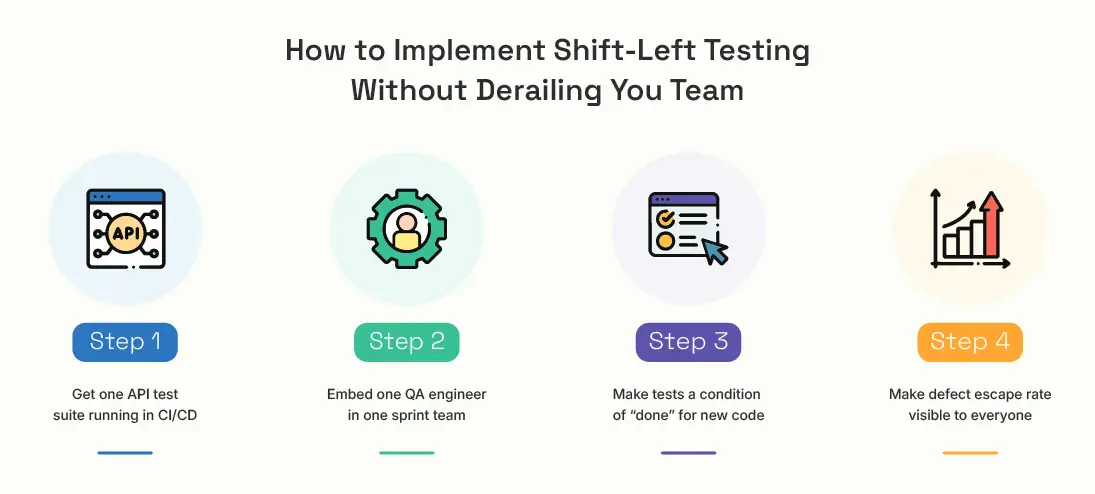
Step 1: Get one API test suite running in CI/CD
Do not start with UI automation or a full regression suite. Pick one critical API that handles your core transaction, authentication flow, or most-used endpoint. Build a test suite around it that runs on every commit.
APIs are stable earlier than UI, faster to test, and far less brittle. A passing API test suite gives your team a concrete, visible win that makes the case for everything that comes next. This is your proof of concept, not your end state.
Step 2: Embed one QA engineer in one sprint team
Do not announce a company-wide shift-left program.
Pick one team. Have a QA engineer join their standups and planning sessions for two or three sprints. Track defect rates before and after.
The data will help make a case for shift-left adoption. People change their minds quickly when they see numbers from a team that did the work.
Step 3: Make tests a condition of “done” for new code
Do not try to retrofit comprehensive test coverage onto existing code immediately. You’ll get locked into a months-long effort that never finishes and demoralizes everyone.
Instead, mandate that all new functionality does not ship without automated tests. Existing code gets covered incrementally. Coverage grows naturally without teams trying to fix everything at once.
Step 4: Make defect escape rate visible to everyone.
Pick one metric and put it somewhere the whole team can see it. For example, take the percentage of defects reaching production each sprint. Track this number specifically, not bugs filed or raw test coverage percentage.
When engineers see that number fall over time as a direct result of what they did, the cultural resistance to shift-left dissolves on its own.
The Goal Is to Make “Shift-Left” Irrelevant
How do you know shift-left testing is actually working on your team? Answer: nobody calls it “shift-left” anymore.
The behavior becomes the default. QA is now part of planning. Tests are part of shipping. Automated checks in the pipeline are how code gets merged. It is Tuesday, and this is how the team works.
Getting there requires real investment in skills, tooling, and organizational habits, often while still delivering on existing commitments. It can be difficult but is entirely doable.
What you get is a team that spends less time in incident response and more time building things. Developers get feedback in minutes instead of days. The QA function prevents problems instead of documenting them after the fact.
That is worth the transition cost and stress.
If you are at the starting stage right now, TestWheel is worth a look. It is built specifically to lower the barrier to shift-left automation, with no-code and low-code test building, AI self-healing for UI tests, and coverage across web, mobile, API, desktop, performance, and security in one place.
Free trial, no coding required, and scales as your team’s practice evolves
Frequently Asked Questions
1. What is shift-left testing?
Shift-left testing means getting QA involved before developers write code, not after. Instead of handing a build to testers two days before release, you catch problems during requirements, design, and development. The earlier a defect gets found, the cheaper and faster it is to fix.
2. Why is it called “shift left”?
Draw the software development lifecycle as a timeline. Requirements on the left, deployment on the right. For decades, testing lived on the right side of that line. Shift-left means moving it toward the left, closer to where decisions are made and code is first written.
3. What is the difference between shift-left and shift-right testing?
Shift-left stops defects from reaching users. Shift-right tells you what happens when they reach them anyway. Shift-right covers canary deployments, production monitoring, chaos engineering, A/B tests: everything that only becomes visible under real traffic with real users. Neither replaces the other.
4. What are the four types of shift-left testing?
The four types of shift-left testing are:
1. Traditional shift-left just moves testing earlier in a waterfall project.
2. Incremental shift-left embeds testing inside each Agile sprint, with tests as part of the definition of done.
3. Model-based shift-left validates system design before any code exists.
4. DevOps/continuous shift-left automates everything across the CI/CD pipeline with quality gates that block bad code on every commit.
Most teams start with traditional and work toward continuous over months or years.
5. What does shift-left testing require to succeed?
Shift-left testing requires four things to succeed. Skipping any one of them tends to sink the effort.
1. Management has to protect the process through the first two to three months when velocity dips before it improves.
2. The codebase has to be testable or actively moving toward it.
3. QA engineers need to be inside sprint teams, not waiting at the end of the pipeline.
4. The metrics have to measure defect escape rate, not bugs filed. That last one matters more than most teams realize.
6. What are the biggest challenges of shift-left testing?
Cultural resistance is usually the first wall.
Developers see testing as someone else’s job. QA engineers worry they are being replaced. Managers pull the plug when velocity dips in month two.
Beyond culture, there is a real skill gap between manual testers and engineers who can write unit tests or review requirements for edge cases.
There’s also test maintenance. Suites that looked healthy at 400 tests fall apart when a CSS class changes. In legacy codebases, you hit the catch-22 where you cannot test without refactoring code and cannot safely refactor code without tests.
7. What is shift-left automation?
Shift-left automation makes shift-left testing scale beyond what any individual can maintain manually.
Static analysis runs on every commit. Unit tests run on every build. API tests run before any pull request merges. End-to-end tests run on deployment to staging, selectively, covering only the paths that matter most.
Quality gates block code from advancing when tests fail. No overrides or exceptions.
8. Is shift-left testing only for large teams?
The core habits, writing tests early, involving QA in planning, blocking merges on failed tests, work at any team size. A two-person startup can practice shift-left.
The tooling and formality look different at different scales, but the principle does not change based on headcount.
9. What metrics actually matter for shift-left testing?
The metrics that matter for shift-left testing are:
1. Defect escape rate to production
2. Defect detection rate by pipeline stage
3. Mean time to detect
4. Test coverage by layer.
What you want to see is the curve shifting left: more defects caught in development, fewer in staging, almost none reaching production.